Why is HSM Considered the Ultimate Guardian of End-to-End Encryption?
Why is HSM Considered the Ultimate Guardian of End-to-End Encryption?
The best encryption today still uses symmetric encryption algorithms such as AES. Symmetric encryption algorithms have a very high level of complexity, so they cannot be easily broken by brute-force attacks using current processor technology.
Quantum computing technology, which is famous for its high speed, is only at the stage of calculating numbers. Therefore the Shor algorithm, which is designed for quantum computing, is very advantageous because it can break the RSA algorithm.
However, this is not the case with complex computing that requires a Turing computation model. Until now, quantum computers have not been able to carry out logical sequence processes that have a speed equivalent to their mathematical calculations, this is very much needed if you want the quantum computing process to be able to brute-force today's encryption technology (other than RSA).
This is why not all encryption algorithms are equal, the development of today's quantum computers is very fast, but they still cannot perform computations that threaten the standard AES encryption algorithm which is still widely used in business.
However, using RSA which is easily broken by quantum computers will also impact systems that use AES, because breaking RSA encryption results in the emergence of the exchanged AES encryption key.
Thus, we must have the best way and mechanism to store keys so that we no longer use RSA, but of course this is not easy, one that can be used is to use HSM as the best key storage, so that it cannot be easily tampered with by other parties.
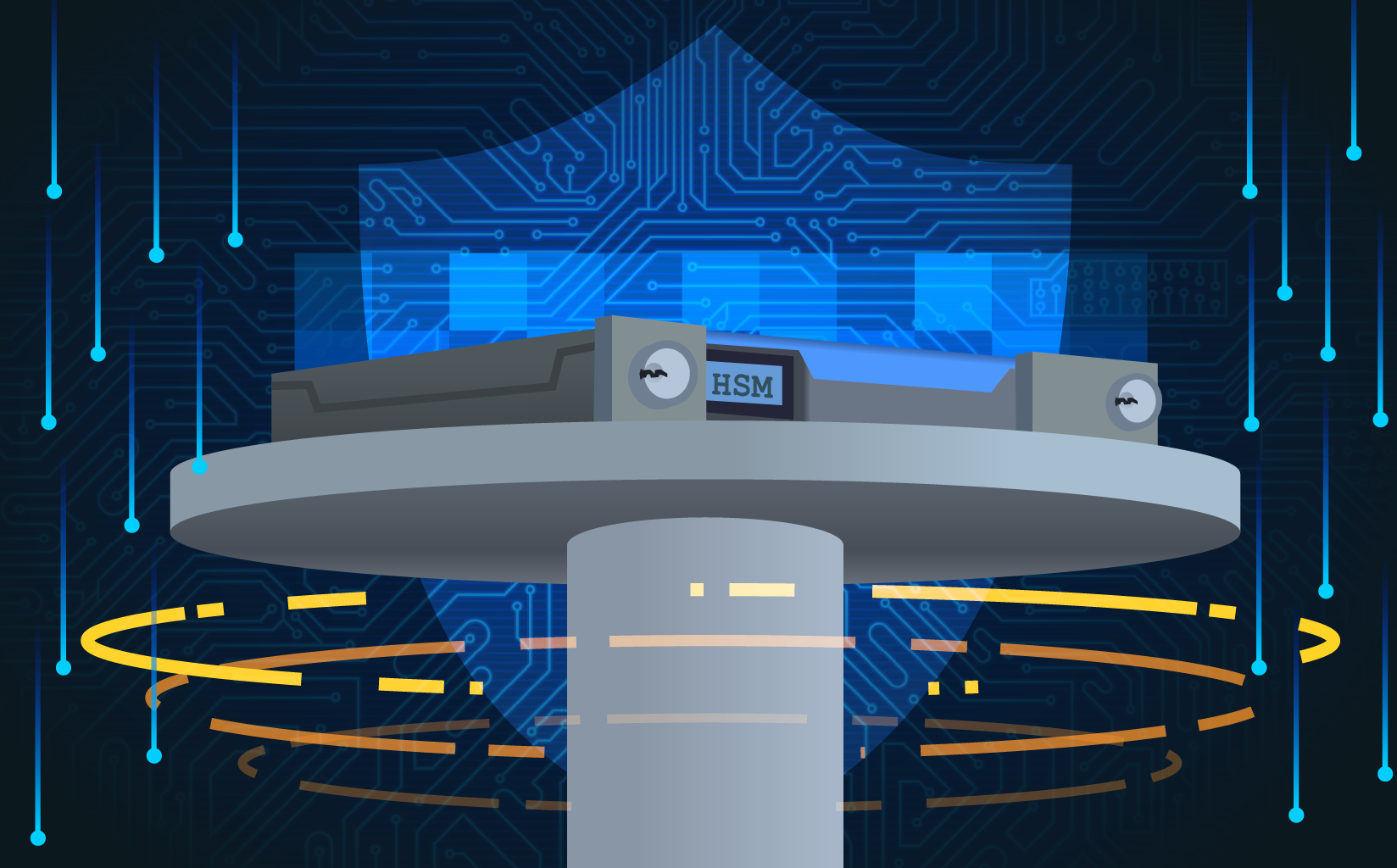
Why can HSM be the best answer for data storage? Data entered into the HSM cannot be easily taken out without the appropriate access, and HSM physically has certain advantages because it cannot be physically tampered with. If there is certain physical access, the HSM will carry out a self-destruct mechanism so no party can get the stored key without going through the appropriate access mechanism.
Is key exchange required to use an HSM?
The answer is: it depends. For data stored on disk (data-at-rest), using an HSM is highly recommended.
However, for securing data-in-motion, such as SSL in HTTPS—using an HSM is not strictly necessary. An alternative is to use randomly generated keys exchanged securely without relying on the RSA protocol. One such method is using the ML-KEM protocol.
To implement ML-KEM, check whether your programming language framework supports it. Look into your TCP or HTTP client libraries, classes, or modules to see if ML-KEM is available. Additionally, ensure that the server you're connecting to also supports ML-KEM.
By understanding the end-to-end structure of encryption and decryption processes, we can better appreciate why HSMs are considered one of the most reliable solutions for securing encrypted systems.